spare parts
Remake a discontinued spare part
Even with no drawing and a broken part: photos, measurements and CAD remodelling. A typical spare costs €30-150 all-in, and the file stays yours.
Marcello BilliAugust 18, 20268 min
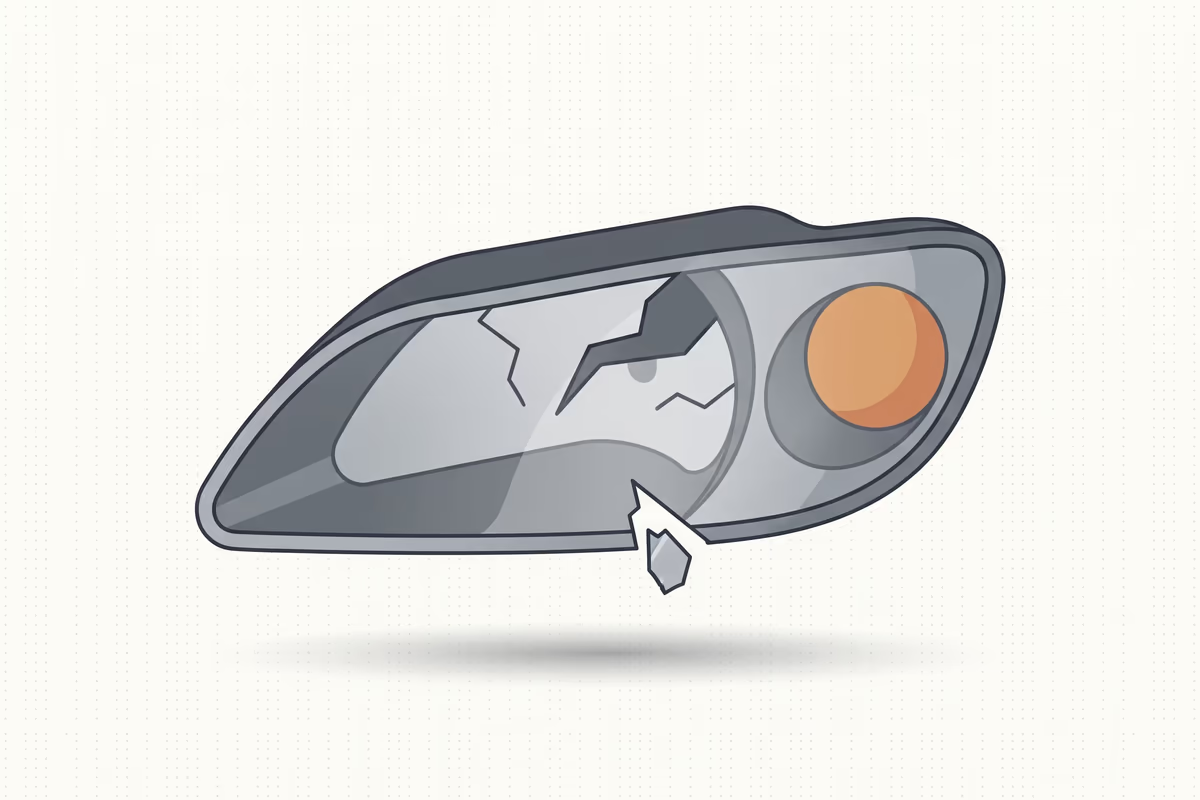
A discontinued spare part can be remade with 3D printing, even if you have no file at all and the part is broken or incomplete. What you need is the part (or photos with measurements), CAD remodelling and the right material for the environment it works in. A typical part costs from 30 to 150 euros all included — far less than replacing the whole appliance or paying collector prices for an original.
In short
- It can be remade even without a file and with the part broken: photos and caliper measurements are enough, then CAD remodelling.
- All-in costs: simple 30-60 euros, medium 60-150, complex 150-400. The real cost is the CAD work, not the printing.
- The modelling is paid once: extra copies only cost the printing, and the file remains yours.
- Material by environment: ASA for sunlight, PA12 nylon for petrol, PA6-CF for the engine bay, TPU for flexible parts. Never PLA on hot parts.
- It's legal for repairing your own product (expired patents, EU repair clause), with no logos and declared "compatible".
The oven knob, the dashboard clip of a classic car, the roller of a dishwasher basket, the housing of a machine the manufacturer no longer supports: the problem is always the same — the part no longer exists and nobody tells you how to get it remade. Here you'll find the complete process, the real costs and the cases where 3D printing is not the right route.
What do you need to get started (even without a file or drawing)?
The starting point depends on what you have in hand. In every case you don't need to know CAD: the service rebuilds the model for you.
| What you have | What to do |
|---|---|
| The 3D file (STL, STEP) | Upload it to the instant quote: price in a few seconds |
| The whole part (even worn) | Sharp photos from several sides + main dimensions taken with a caliper |
| The broken part in two or three fragments | Photos of the fragments placed together + measurements: it's rebuilt in CAD |
| An incomplete part (a piece is missing) | The missing geometry is worked out from the symmetrical side or from the seat it mounts into |
| Only the seat (the part is lost) | It's designed from scratch by measuring the mating part: screws, fits, overall dimensions |
And no, 3D scanning is almost never needed. A part made of regular shapes (brackets, knobs, clips, gears, covers) is better measured with a caliper and redrawn in CAD: more accurate than a hobby scanner, which returns a messy mesh that takes hours to clean up. Scanning only pays off on complex organic surfaces, like a shaped fairing.
How it works, step by step
- Assessing the part. Why did it break? Where does it work (heat, sunlight, petrol, load)? Material and design changes come out of this.
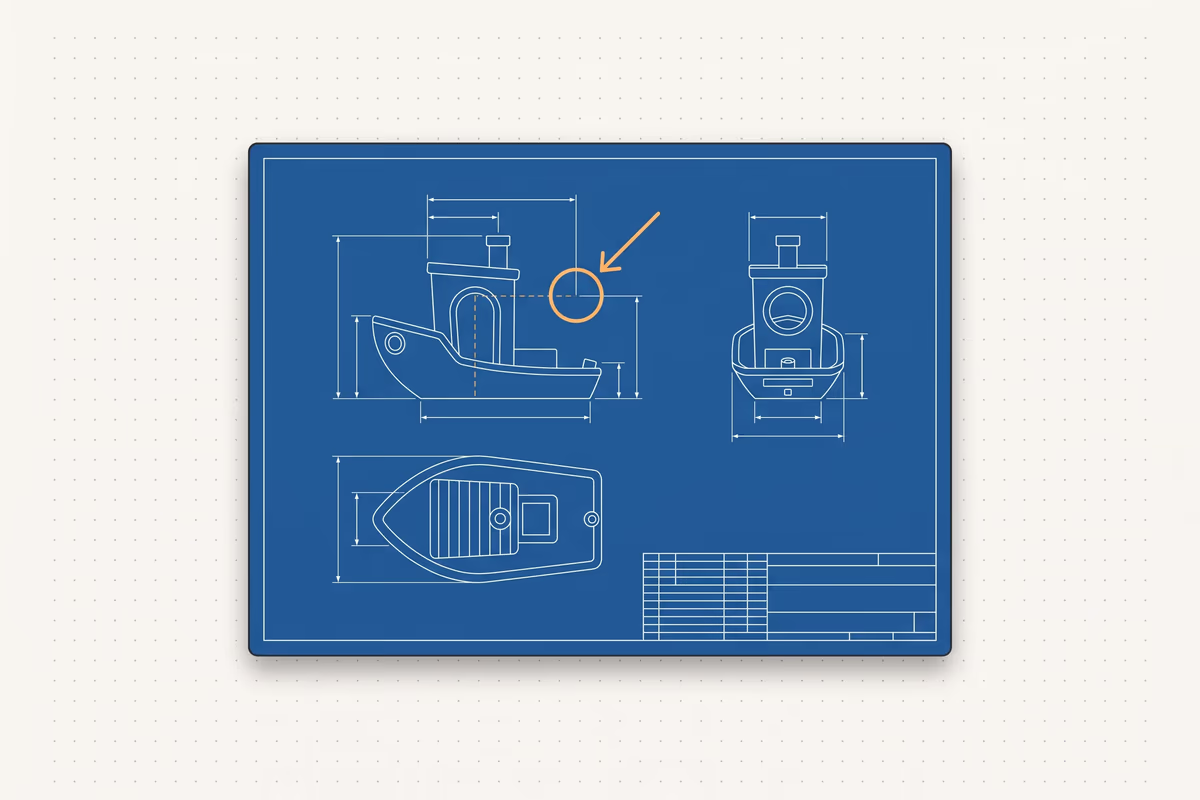
- Measuring. Dimensions from the physical part, from dimensioned photos or from the mating part. The dimensions of an industrial part are almost always round numbers: 25.4 mm is one inch, and the model is rebuilt with logic, not by copying the wear.
- CAD remodelling. The part is redrawn from scratch as a clean solid. It's also the moment to reinforce it where it broke: fillets, ribs, thicker walls. The printed copy can come out better than the original.
- Preview and confirmation. You see the 3D model and the dimensions before anything is printed.
- Printing and fit test. On critical fits it's normal to budget for a test print: FDM holes come out 0.1-0.3 mm undersized and the perfect fit is nailed on the first or second iteration.
How much does it cost to remake a discontinued spare part?
The main cost item isn't the printing, it's the CAD modelling. Printing a small part costs a few euros of machine time and material. Rebuilding the model is another matter: it takes hours of work and experience to capture the right dimensions, interpret the wear, understand where to reinforce and draw a solid that prints well on the first try. That's what you're paying for, and it's the reason the part arrives ready to fit. Some concrete reference figures, all included:
| Part | Examples | Indicative cost |
|---|---|---|
| Simple | Knob, clip, spacer, hook, handle | 30-60 euros |
| Medium | Shaped bracket, geared roller, hinge, mount | 60-150 euros |
| Complex | Housing, grille, duct, panel, large part | 150-400 euros |
If you need more than one copy the numbers improve straight away: the modelling is paid once, and extra copies only cost the printing (for small batches see how contract 3D printing works). And the file remains yours: if the part breaks again in two years, it's reprinted the same day. To understand how the print price is built, read how much 3D printing costs; if you already have the file, here's how to prepare it.
Will the part hold up? The right material for every environment
It's the number one fear, and it's well founded: nearly every printed spare part that fails was printed in the wrong material (usually PLA on hot parts). The rule is to choose the polymer for the environment the part lives in, not for the price of the filament.
| Where the part works | Material | Holds up to |
|---|---|---|
| Indoors, household environment | PETG | ~65-70 °C |
| Outdoors, sunlight, dashboard | ASA (UV-stable) | ~95 °C |
| Petrol, oils, greases | PA12 nylon (used in real fuel lines) | ~100 °C |
| Gears, friction, impacts | PA nylon, plain or filled | ~100 °C |
| Engine bay, high heat | PA6-CF / PAHT-CF (carbon fibre) | 150 °C and above |
| Gaskets, flexible parts | TPU | room-temperature use; stays elastic, doesn't crack |
Two precautions that matter as much as the material. First: the part must be oriented in printing so the load pulls along the layers, because the bond between layers is much weaker than the material in plane (strength in the XY plane is typically 4-5 times the strength along Z). Second: if the original broke at one specific spot, the design must be reinforced there, not copied.
There is, however, one deliberate exception: some parts are fragile on purpose. In a wire-feed welder the plastic gear acts as a mechanical fuse — it breaks to save the gearbox that costs ten times as much. In those cases the spare part should be made as strong as it needs to be to work for months, but no stronger than the original, otherwise the failure moves to the expensive component. The real figures for every material, temperature included, are in our materials guide; to help you choose, there's also the guide on which material to use for each application.
Is it legal to remake a spare part?
In the vast majority of cases yes, and it's worth knowing why. Patents last 20 years: on a discontinued product they have almost always expired. A registered design lasts at most 25 years, and for purely functional internal parts it usually never existed in the first place: a clip, a roller or a lever isn't a protected work. On top of that, the European Union has made the repair clause permanent (2024 design reform): spare parts intended to restore a product's original appearance can be produced legally, as long as it's clear they aren't original.
The real limits are two, and a serious service always respects them:
- No logos or trademarks. Trademarks never expire: the part is reproduced without any lettering and declared "compatible, non-original".
- No copies of other people's files. Remodelling your physical part from scratch is a clean position; downloading and printing the STL of a protected design is not (the EU reform treats even sharing the file as an infringement).
Doubt only remains around recent parts, still in production or tied to a registered design: there it's worth checking before going ahead, and asking when in doubt. For a product the manufacturer abandoned years ago, repair is exactly the case the law chose to protect.
When 3D printing is not the right answer
There are, however, parts that aren't worth printing:
- Safety parts: brakes, steering, suspension, pressurised components or parts in contact with gas, live electrical components. Printed materials don't carry the certifications to gamble with someone's safety.
- Prolonged contact with flame or temperatures above 250 °C: beyond the ceiling of even technical polymers.
- Integrated flexible hinges (living hinges): injection-moulded polypropylene ones withstand thousands of cycles, an FDM copy in the wrong material lasts dozens. It's redesigned with a pin, or replaced with an off-the-shelf hinge.
- Transparent optical parts (lenses, clear light covers): FDM gets to translucent at best.
- Parts still on sale at a normal price: if the original costs 8 euros and arrives tomorrow, buying it is the sensible choice. Reprinting wins when the part no longer exists, sells at collector prices, or keeps an appliance that would cost 400 euros new out of action for weeks.
Where do you start?
Go to the instant quote and choose the design route: attach photos of the discontinued spare part (whole or broken), the main dimensions taken with a caliper and a couple of lines on what it does and where it works. We take care of the rest: we remodel it in CAD, send you the preview to approve and print it in materials suited to indoor or outdoor use; the full service is described on the services page. If the part is hard to photograph or measure, you can also ship it to us: we receive it, measure it and send it back together with the new spare part. Already have the 3D file? Upload it and you'll see the price in a few seconds. On timing: with the file ready, printing usually takes 24-72 hours plus shipping; if CAD remodelling is needed, add a few days for measuring, drawing and the preview. Technical reply within 24 hours, and the person answering is the person doing the printing.
MB
Marcello Billi — technical lead ForgeCore
Spare parts remodelled from the physical piece every week: send two photos and I'll tell you right away if it can be done.
Upd. 08.20.2026
Frequently asked questions
Can a spare part that's no longer available be 3D printed?
Yes. You need the physical part (even broken or incomplete), or photos and measurements: a technician remodels it in CAD and prints it in a material suited to the environment it works in. It's the standard route for discontinued spare parts for appliances, classic cars, campervans, machinery and furniture.
How much does it cost to have a spare part remade with 3D printing?
Roughly 30-60 euros for a simple part (knob, clip, hook), 60-150 euros for a medium part (bracket, gear, hinge), 150-400 euros for large or complex parts. The main cost item is the CAD modelling, not the printing: you pay for it once, and every extra copy costs just a few euros.
I don't have the 3D file and the part is broken: can it still be done?
Yes, and it's the most common case. You start from photos and caliper measurements, from the fragments placed together, or from the seat the part mounts into. Missing geometry is worked out from the symmetrical side or from the mating part. 3D scanning is only needed for complex organic surfaces: for geometric parts a caliper is more accurate.
Will a 3D printed part hold up like the original?
Yes for the vast majority of household and technical spare parts, as long as the material and print orientation are right. Nylon handles gears and friction, ASA handles sunlight, carbon-fibre composites go beyond 150 degrees. On top of that, the spot where the original used to break can be reinforced during remodelling.
What material is used for a car spare part or the engine bay?
It depends on where it works: ASA for outdoor use and dashboards (UV and around 95 degrees), PA12 nylon for contact with petrol and oils, carbon-fibre PA6-CF or PAHT-CF for the engine bay (150 degrees and above), TPU for gaskets and flexible parts. PLA should be avoided on any hot part.
Is it legal to have a spare part for a branded product printed?
To repair your own product, almost always yes: patents last 20 years and have expired on discontinued products, purely functional shapes aren't protected, and the EU repair clause covers appearance parts. The limits: never reproduce logos or trademarks, and the part is declared a compatible, non-original replacement.
Which spare parts can't be 3D printed?
Safety parts: brakes, steering, suspension, pressurised components or parts in contact with gas, live electrical components. Then the technical cases: contact with open flame or temperatures above 250 degrees, integrated living hinges, transparent optical parts. A serious service says no to these.
How long does it take to get the spare part?
With the file already in hand, the quote is instant and printing usually takes 24-72 hours plus shipping. If CAD remodelling from the physical part is needed, add one to a few days for measuring, drawing and the preview to approve before printing.
Is it better to print the spare part or hunt for a used original?
If the original can be found at a normal price, buy it. Reprinting makes sense when the part no longer exists, sells at collector prices or takes weeks to arrive from abroad: a reprinted functional part almost always stays under 150 euros, the file remains yours and future copies cost just a few euros.
Can the original logo go on the remade part?
No. Trademarks never expire, so reproducing the manufacturer's logos, names or lettering is counterfeiting even on a 50-year-old part. The spare part is printed without any branding and declared a compatible, non-original replacement: that's the condition that keeps it legal.